How to Choose a Delivery Bag Manufacturer in Pakistan for B2B Orders
Choosing a delivery bag manufacturer in Pakistan involves more than requesting the lowest quotation. A commercial buyer needs equipment that matches packaging dimensions, rider workflow, weather exposure and expected daily usage.
Restaurants, pizza shops, courier companies, grocery businesses and pharmacy chains all need different bag designs. A capable manufacturer should understand these differences and guide the buyer through material, size, insulation, frame and branding before production.
The live Delivery Bags Manufacturer site positions its own process around this type of B2B specification, highlighting custom manufacturing, OEM/private label, bulk orders and Pakistan-wide delivery.
Why Manufacturer Selection Matters
A poor supplier decision can create repeated problems. Bags may arrive in the wrong size, zippers may fail quickly, logos may be inconsistent or materials may not match the approved sample.
These problems become more serious when a company orders dozens or hundreds of units.
Choosing a reliable commercial delivery bag manufacturer therefore protects both the procurement budget and daily delivery operations.
Start With Industry Experience
A supplier that understands one restaurant bag does not automatically understand courier or grocery requirements.
Ask whether the manufacturer has produced bags for businesses similar to yours.
A pizza shop needs horizontal pouches, while a courier fleet needs strong backpacks. Industry knowledge helps reduce specification errors before production begins.
Important Questions to Ask the Manufacturer
Before approving an order, ask about:
- Available materials and material quality levels
- Standard and custom size manufacturing
- Insulation and internal lining options
- Wire or pipe frame construction
- Custom printing and logo methods
- Production time, quantity and repeat supply
Clear answers to these questions reveal whether the supplier understands commercial manufacturing or is simply reselling generic bags.
Check the Manufacturer’s Product Range
A broad but relevant product range can indicate experience with different delivery applications.
Businesses should look for specialized Food Delivery Bags, Pizza Delivery Bags and Courier Delivery Bags rather than one generic bag marketed for every use.
A specialized range also makes it easier for growing businesses to add new bag types later.
Evaluate Material Knowledge
A strong manufacturer should be able to explain the differences between parachute fabric, rexine, PVC and tarpaulin.
Instead of saying one material is simply “best,” the supplier should explain which applications each material suits.
This indicates a more consultative manufacturing process and helps buyers avoid paying for unnecessary specifications.
Ask About Actual Material Construction
Material names alone are not enough.
Buyers should also ask about thickness, lining, stitching and reinforcement because two bags described as tarpaulin can still have significantly different durability.
A professional manufacturer should be willing to explain what construction is included in the quotation.
Check Custom Size Capability
Businesses often use packaging that does not fit standard dimensions perfectly.
A good custom delivery bag manufacturer should be able to manufacture around actual pizza boxes, takeaway packaging, grocery baskets or courier parcel requirements.
The current site emphasizes custom dimensions as part of OEM and private-label production.
Ask About Insulation
Food and pizza delivery bags commonly require foam insulation.
The manufacturer should explain available insulation options and how bag dimensions influence practical performance.
Businesses should be cautious of unrealistic claims suggesting a standard insulated bag can maintain any temperature indefinitely.
Compare Structural Frame Options
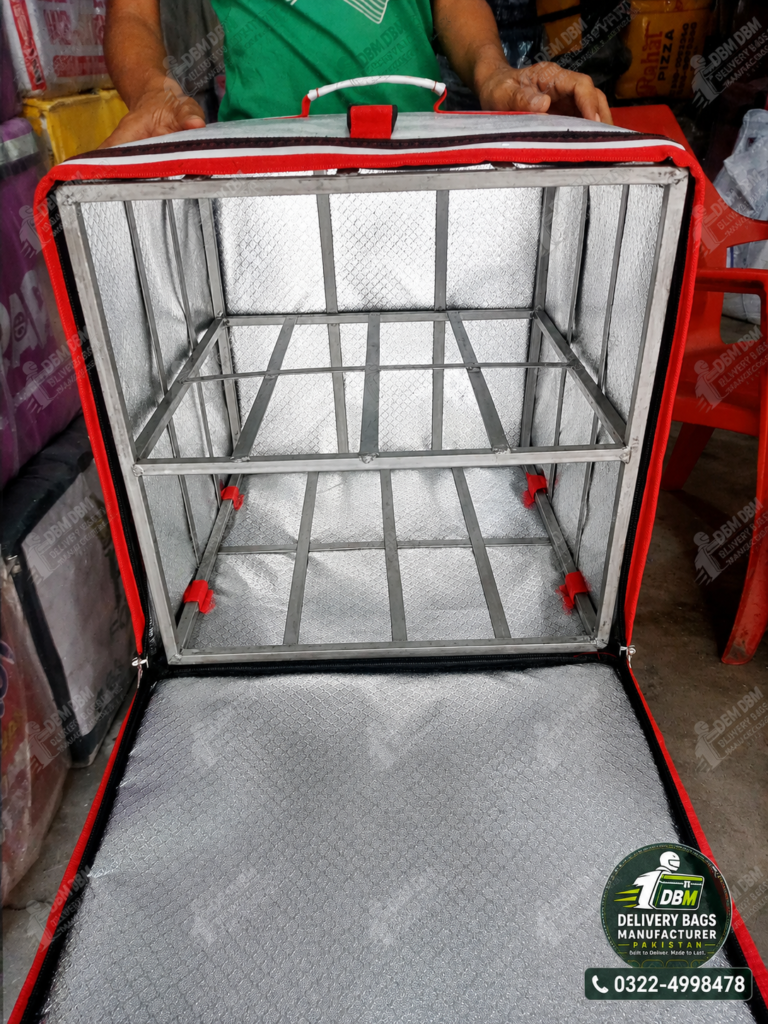
Frames help delivery bags maintain shape during loading and transportation.
Some applications may only need a light wire frame, while grocery and courier fleets may require stronger pipe construction.
The live manufacturer’s process specifically lists frame quality as one of the variables buyers can select during ordering.
Evaluate Stitching and Zippers
Many bag failures occur at stress points rather than across the main material surface.
Shoulder straps, handles, corners and zippers need appropriate reinforcement.
Procurement teams should inspect these areas on samples or completed bags before placing large repeat orders.
Check Custom Logo Capabilities
Branding is important for restaurants, couriers and delivery platforms.
A capable manufacturer should offer custom logo delivery bags using methods suitable for the chosen fabric.
The current site promotes flex, reflective flex, screen printing, UV printing and embroidery for different branding requirements.
Buyers can explore Custom Logo Delivery Bags for branding-specific requirements.
Ask for Artwork Approval
Never approve a large production run without verifying artwork.
Logo dimensions, spelling, phone numbers and website details should all be confirmed before printing starts.
A simple approval step can prevent the same branding error from being repeated across dozens of finished bags.
Look for OEM and Private Label Support
OEM capability can be particularly useful for restaurant chains, distributors and companies building their own delivery equipment standard.
Private-label manufacturing can include custom dimensions, colors, logo placement and additional operational features.
The live site specifically promotes OEM and private-label support for commercial buyers and wholesalers.
Check Bulk Manufacturing Capability
A supplier may be able to produce several bags but struggle with consistent larger batches.
Businesses planning expansion should ask about production capacity and quality-control procedures.
A manufacturer suitable for bulk delivery bags should be able to maintain dimensions, material and artwork across the whole order.
Buyers can review Bulk Order Delivery Bags for fleet procurement.
Understand Quantity-Based Pricing
Bulk pricing should reflect actual specifications.
The current manufacturer’s pricing tables demonstrate quantity-based price differences for selected bag sizes and materials, while clearly noting that logo printing, frame quality and customization affect final cost.
Buyers should therefore avoid asking only, “What is your cheapest delivery bag?”
Compare Equivalent Quotations
Supplier A may quote a parachute bag with a wire frame, while Supplier B quotes tarpaulin with a pipe frame.
Comparing only the final price creates a misleading result because the specifications are not equivalent.
Procurement teams should create one written requirement and request every supplier to price that same configuration.
Review Quality-Control Processes
Ask what the manufacturer checks before dispatch.
Important areas include stitching, zipper movement, strap strength, frame shape, logo placement, finishing and packing. These are also listed in the manufacturer’s current published quality-control process.
A defined QC process is particularly important for bulk orders.
Look at Actual Production Experience
A website containing real product categories, delivered-order examples and relevant technical information can provide useful evidence of operational experience.
The live manufacturer site currently emphasizes real production photos, delivered orders and custom manufacturing as part of its credibility positioning.
Commercial buyers should still verify specifications directly before transferring funds or approving production.
Check Repeat-Order Capability
A good supplier relationship becomes more valuable over time.
Restaurant chains and courier companies may need the same bag again months later when opening new branches or recruiting riders.
Ask whether the manufacturer can reproduce the approved dimensions, colors and artwork from previous orders.
Pakistan-Wide Supply Capability
Companies operating several cities need a manufacturer that can support distribution beyond the factory location.
The live site currently lists Lahore, Karachi, Islamabad, Rawalpindi, Faisalabad, Multan, Peshawar, Quetta and other cities within its Pakistan-wide supply network.
Buyers should confirm dispatch method, delivery cost and lead time before approving the order.
Manufacturer Versus Trader
Buying from a trader is not automatically bad, but commercial buyers should understand who is actually producing the bags.
Direct manufacturing may provide greater flexibility for custom dimensions, branding and repeat production.
Traders can still provide value through local inventory and customer service, but buyers should understand the supply chain before expecting factory-level customization.
Check Wholesale Support
Distributors should ask whether the manufacturer supports quantity-based resale and private-label orders.
A supplier that understands wholesaler requirements can help maintain consistent specifications across repeat batches.
Resellers can compare Wholesale Delivery Bags for commercially focused supply options.
Do Not Select Solely on Price
A bag that costs less but fails earlier may create more expense over time.
Replacement cost, rider disruption and damaged brand appearance all contribute to total ownership cost.
Businesses should balance unit price against durability and expected usage instead of automatically choosing the lowest quotation.
Use a Sample or Approved Specification
For important fleet orders, buyers should keep one approved sample or detailed written specification.
This gives both parties a clear benchmark during future production.
The reference should include dimensions, material, foam, frame, colors, printing and all additional features.
Review Payment and Production Terms
Before paying, buyers should understand how the quotation, artwork approval, production and dispatch process works.
The current live site indicates that custom B2B items use confirmed payment terms rather than ordinary Cash on Delivery.
Businesses should verify official account details and written order specifications before transferring funds.
Final Thoughts
The right delivery bag manufacturer in Pakistan should combine manufacturing knowledge, material options, custom sizing, reliable construction, branding support and repeat-production capability.
Restaurants, couriers and procurement teams should evaluate the supplier as carefully as they evaluate the bag itself. More buying guidance can be connected through the Delivery Bags Manufacturer Blog to create a complete B2B research journey for website visitors.
Frequently Asked Questions
1. How do I choose a delivery bag manufacturer in Pakistan?
Compare industry experience, materials, custom sizing, insulation, frame construction, printing capabilities, quality control and repeat-production support.
2. Should I buy directly from a manufacturer or trader?
Direct manufacturers can be useful for customization and larger orders, while traders can be suitable for ready stock. The right option depends on your needs.
3. Can a manufacturer create custom delivery bag sizes?
Yes. Custom manufacturing can be used for specific pizza boxes, restaurant packaging, groceries and courier parcel requirements.
4. What materials should a good manufacturer offer?
Common commercial choices include parachute fabric, rexine, PVC and tarpaulin.
5. What logo printing options should I look for?
Depending on fabric and artwork, options may include flex, reflective flex, screen printing, UV printing and embroidery.
6. How can I compare delivery bag quotations?
Send the same written specification to each supplier and compare identical material, size, insulation, frame, branding and quantity.
7. What should be checked before bulk production?
Confirm dimensions, material, artwork, logo placement, frame, stitching and sample quality before production begins.
8. Can manufacturers supply delivery bags across Pakistan?
Many manufacturers support nationwide dispatch. Delivery location and transport cost should be confirmed during quotation.
9. Is the cheapest manufacturer always the best option?
No. A lower initial price can result in higher replacement costs if construction quality is inadequate for commercial use.
10. Why is repeat-order capability important?
Businesses may need matching bags later for new riders and branches, so the manufacturer should be able to reproduce the approved specification.