
Food Delivery Bag Sample Trial for Motorcycle Deliveries in Pakistan
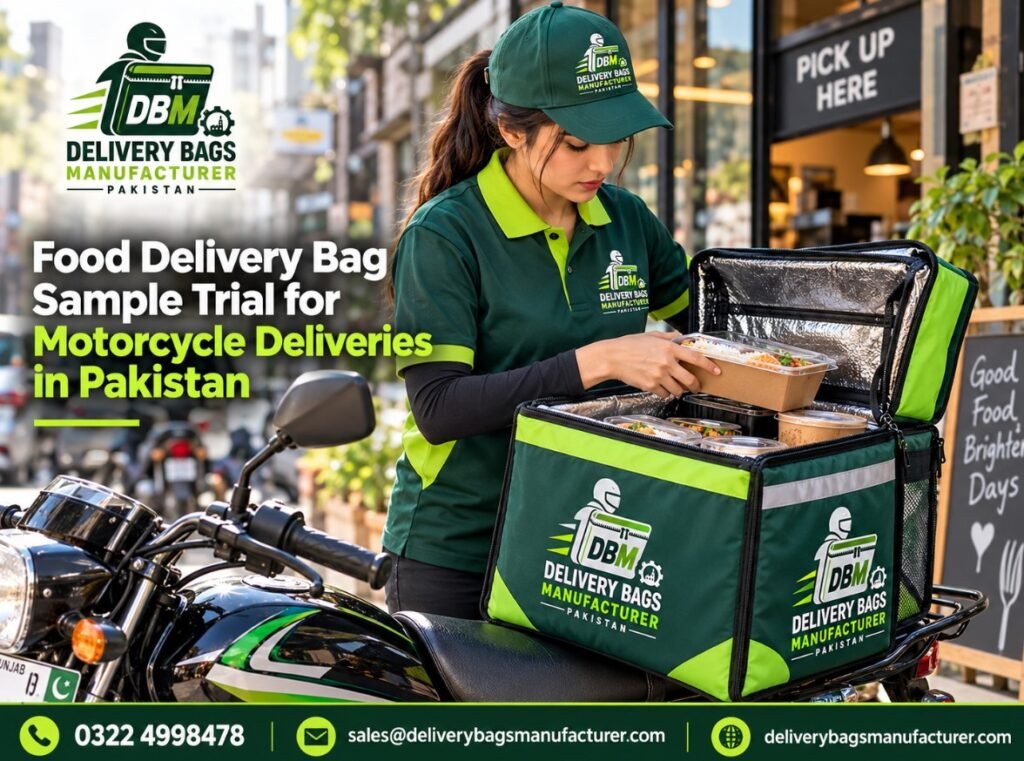
Before purchasing a food delivery bag for motorcycle deliveries, try the sample with your actual takeaway packaging. A photograph shows its appearance, but not whether a large meal box passes through the opening or a rider can remove one order without disturbing another. A trial gives you answers before you equip the whole team. It also helps explain requested changes to the supplier.
For Pakistan restaurants, the trial should reflect the dispatch and handover routine used by the business. Include the usual sealed containers, outer bags and drink arrangements. Assess the proposed carrying method with the people who will use it. A bag that looks convenient on a counter still needs to work during collection and customer handover.
Planning a Food Delivery Bag Sample Trial
Choose representative orders before the sample arrives. Include an ordinary single order, a larger routine order and any packaged combination that has caused a problem with current bags. Record dimensions and the intended arrangement for each. Keep unusual event loads separate if they require a different format.
Agree the questions that determine acceptance. These might concern loading clearance, lid pressure, retrieval, supported carrying and cleaning access. Identify any required thermal assessment separately with the responsible operations team. Avoid declaring the bag “passed” because it performed one task while another remains unresolved.
Start your comparison with food delivery bags for restaurants. Ask which available model is being sampled and whether it uses the same components as the proposed order. Your trial needs to identify what product its results actually describe.
Choosing a Motorcycle Food Delivery Bag Format
| Bag format | Business use | Packaging requirement | Purchasing consideration |
| Food delivery backpack | Rider collection and handover | Sealed meal orders fitting the compartment | Loaded fit, adjustment and retrieval |
| General food carrier | Kitchen-to-rider or vehicle transfers | Supported takeaway boxes | Carrying method for the actual route |
| Flat pizza pouch | Pizza-box dispatch | Box footprint and approved stack height | Horizontal support and closure clearance |
| Structured pizza bag | Repeated stacked-box orders | Boxes fitting without compression | Access to lower orders and base support |
| Catering carrier | Covered trays and event transport | Tray dimensions and lifting clearance | Suitable carrying points and transport plan |
Use motorcycle rider delivery bags to compare backpack formats. For a pizza-led menu, check pizza delivery bags for boxed orders separately. A tall backpack and a flat pouch should not be assumed to solve the same packaging problem.
Restaurant Bag Sizing and Usable Internal Space
Inspect the inside after the liner, base panel and dividers are installed. Measure the usable width, depth and height as agreed with the supplier. Check the narrowest opening as well as the compartment. The advertised external size may include structure and padding that do not provide usable storage space.
Load complete dispatch packages, including sealed lids and outer bags. Observe whether paper handles fold into the closure or containers catch on liner seams. Ask kitchen staff to repeat the loading task without rearranging the order into an unrealistic pattern. If a box fits only when tilted in a way your operation cannot accept, record that as a fit issue.
Close the loaded bag normally. Inspect for pressure on lids, cups or pizza boxes, and check whether the zipper runs without forcing it. A bag that closes only when the container is compressed should not be accepted as the correct size. Discuss a dimensional or layout change before assuming a heavier fabric will resolve the problem.
Rider Carrier Fit and Loaded Handling
Record the weight of representative packed orders and ask for the supplier’s intended load rating. Do not infer that rating from volume, a pipe frame or the thickness of the straps. Load capacity concerns the complete construction and the agreed carrying method. If evidence is missing, treat the limit as unresolved.
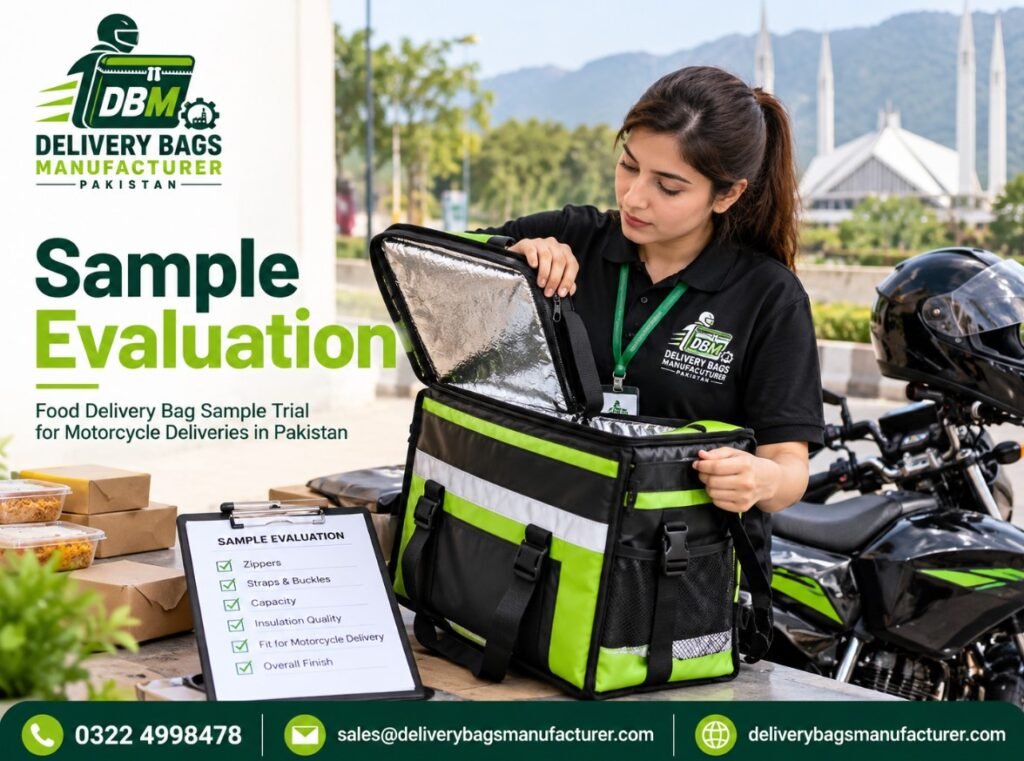
Begin rider assessment in a controlled stationary setting. Have users adjust the harness and evaluate loading, lifting, access and comfort with the agreed sample load.
Any on-road assessment should follow the business’s established rider and vehicle procedures. This article does not prescribe improvised mounting or securing methods. Confirm the intended use with the supplier and responsible operations staff before a route trial. A backpack design and a vehicle-mounted carrier need separate assessment.
Food Delivery Bag Collection and Customer Handover
Simulate the point where the kitchen passes a packed order to the rider. Check whether order labels remain readable and whether staff can confirm the correct package without unnecessary unpacking. Consider where receipts and accessories belong. Pockets should make the workflow clearer rather than scatter one customer’s items across unrelated compartments.
Then rehearse the customer handover. If the route carries more than one order, remove the first while leaving the second undisturbed. Check whether containers remain upright and the closure can be secured again normally. The location of a zipper or divider becomes important when riders repeat this sequence throughout a shift.
For a hypothetical cloud kitchen serving boxed meals and sealed drinks, one sample might allow straightforward meal removal but trap the drink holder beneath another order. The kitchen could request a revised arrangement and repeat that part of the trial. This example illustrates how to document a problem. It is not a claim that a particular product has that defect.
Food Delivery Bag Organization and Temperature Control
A divider may help keep packaged orders apart, but it does not automatically create separate hot and cold zones. Define how chilled drinks, desserts and hot meals will be handled under your food procedures. Separate carriers may be required for some combinations. Do not infer temperature independence from the presence of a compartment.
Thermal performance should be assessed using representative conditions and a suitable measurement plan. Record the starting conditions, packaged load, journey assumptions and opening frequency. An insulated bag supports temperature management but does not certify that every order remains within required conditions. A quick touch test or fixed advertising promise should not replace an appropriate evaluation.
Also consider food texture with the restaurant’s packaging choices. Condensation, container venting and the carrier arrangement interact during transport. If texture is a recurring issue, assess the complete dispatch setup. Changing only the bag’s opening or liner without recording the conditions may make it difficult to understand what helped.
Motorcycle Food Delivery Bag Weather and Cleaning Checks
Define the rain exposure your business expects the carrier to handle. Ask whether “waterproof” refers to the outer material or the complete bag. Zippers, stitching, seams and the base deserve separate attention. Request relevant evidence where protection is essential rather than assuming a coated fabric seals every opening.
Review cleaning before purchase. Open the empty sample and check access to the base, corners and areas behind removable parts. Ask for the approved method and drying instructions. A carrier that takes an impractical effort to clean may be unsuitable for your routine even if its dimensions are right.
Do not assume soaking or machine washing is permitted. The complete bag may include components with different care needs. Ask how damaged inserts or lining should be handled and whether replacements are available for the chosen model. Record only confirmed service options in your purchasing decision.
Recording Food Delivery Bag Sample Trial Results
Keep the comparison practical and consistent. Use the same packaged orders, users and tasks where possible, and record differences that could affect the result. Include:
Sample model, construction and differences from the quoted bag.
Internal measurements and approved packaged-order arrangements.
Loading and closure problems observed by kitchen staff.
Carrying and retrieval observations from intended users.
Weather evidence and written maintenance instructions.
Required changes, acceptance decision and sample revision.
This record avoids relying on the strongest opinion in the room. It also gives the supplier a precise explanation of what needs changing. Repeat affected checks after a revision. Do not assume an alteration to the frame or insert leaves every other result unchanged.
Custom Logo Delivery Bags and Sample Approval
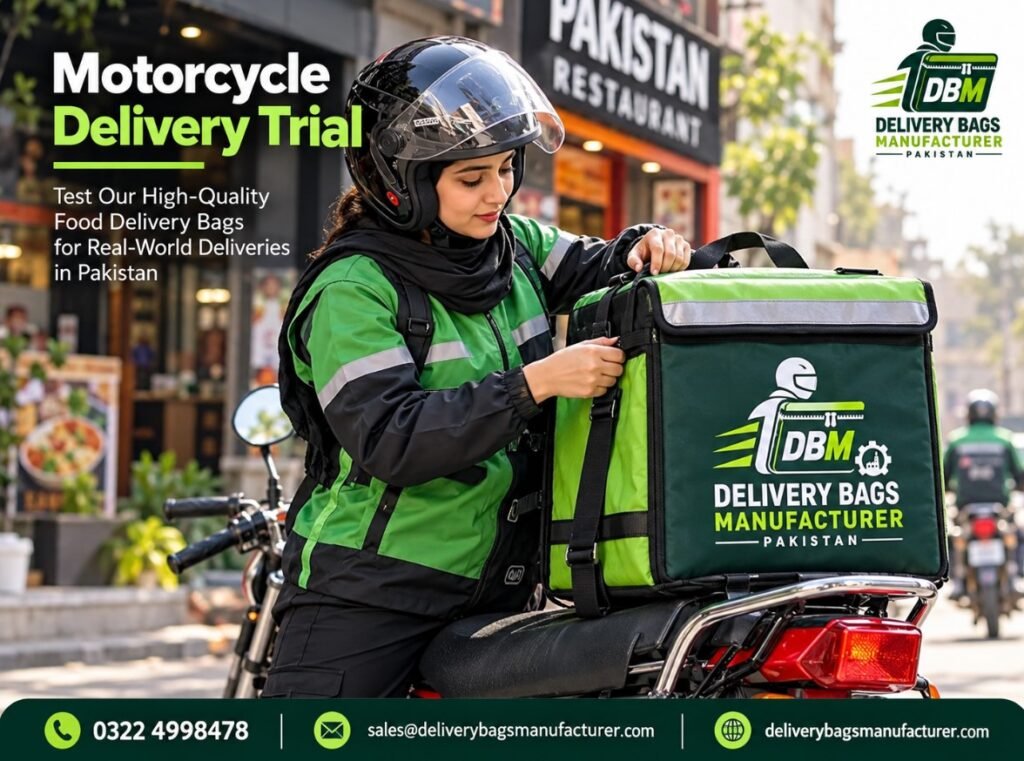
Once the carrier works for the intended routine, review artwork size, placement and application method. Keep logos clear of closures and areas that fold heavily where relevant. Check the approved design on the chosen material. Artwork suitable for one construction may need adjustment on another.
Use custom logo delivery bags for restaurant fleets to discuss available treatments. Confirm whether the sample price includes branding and whether setup costs apply to the order. Retain the approved artwork and bag revision together so production uses the correct combination.
Frequently Asked Questions about Food Delivery Bag Sample Trials
How many sample orders should we test?
Test the representative packaging arrangements the bag is expected to carry, including routine larger loads and known problem combinations. There is no universal number that proves suitability. Define the scope around your menu and carrying routine. Record which arrangements are approved and which require a different carrier.
Is a bigger food delivery bag always more useful?
No. Additional space may not help if the opening is awkward or ordinary orders move around inside. Assess the bag with your real packaging and intended users. A second suitable size can be more practical than one oversized model. Make that decision through the trial rather than advertised volume.
Can a trial establish how many hours food stays hot?
A properly planned thermal assessment can provide evidence for its recorded conditions. A basic fit and handling trial cannot establish a retention-time claim. Ask the responsible team to define the required measurement method and representative conditions. Do not generalize one result to every menu item, route or opening routine.
Should all riders try the same harness adjustment?
No. Evaluate adjustment and loaded handling with representative intended users following the supplier’s instructions. Record whether the design accommodates their needs. One comfortable fit does not prove suitability for every rider. Include any required changes in the sample feedback before ordering a fleet quantity.
What if the sample differs from the bag quoted?
Ask the supplier to identify the differences before drawing conclusions. A demonstration can help assess general format, but changes in structure, lining or inserts may affect fit and use. Request the relevant production configuration for approval. Link your acceptance record to the actual build being ordered.
Should we order the full fleet after one successful demonstration?
First review all defined acceptance checks, outstanding questions and commercial terms. A demonstration may not cover maintenance, weather evidence or repeated use. Consider an agreed initial deployment where appropriate, then use operating feedback to inform expansion. Do not treat an unfinished review as complete because the bag looks promising.
Conclusion: Choosing a Food Delivery Bag after a Sample Trial
Approve the food delivery bag only after the agreed packaging, handling and maintenance checks are complete. Keep the trial record linked to the quoted model so the bag ordered for your riders matches the configuration your team evaluated.
Send the trial record, packaging measurements, quantity and branding requirements through food delivery bag sample trial and quotation inquiry. Ask for an offer matching the approved configuration. A food delivery bag selected through clear practical checks gives your kitchen and riders a more useful purchasing reference.